Learn to master powerful cognitive tools and methods to build the critical thinking region of your brain — so you can finally break free of unconscious conditioning.
Why? Because if you don’t know how you think, then your unconscious will keep running the show.
Choose between our 10 week program or ThinkMind Classes to get started.
Our ThinkMind classes give you a hands-on demonstration and application to the tools that shape top 1% critical thinkers.
ThinkMind Classes – Mind Maps: The Most Powerful Think Tool Known to Man.
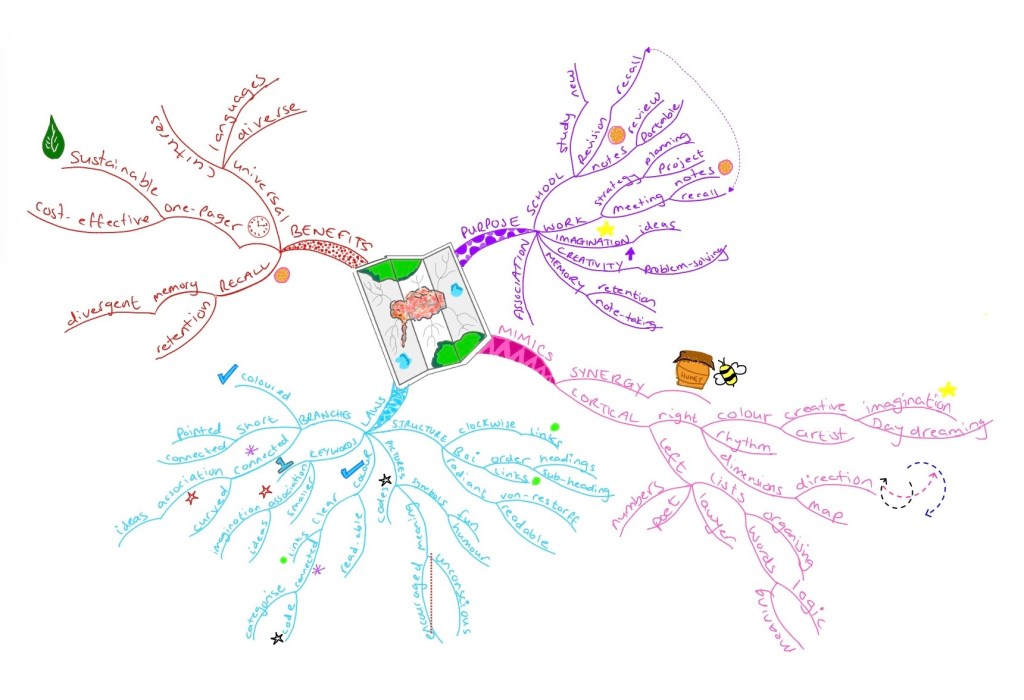
What if the most powerful thinking tools ever created has been sitting in plain sight?
Mind Mapping isn’t just a brainstorming hack. It isn’t a productivity trend. It is the only tool known to man that mirrors exactly the way your brain neurons work. When you use it the way it was designed to be used, it doesn’t just organise your thoughts – it transforms them.
PRICE: £399 (2 days)
DATES: 11 and 12 May, 11:00 – 16:00 (UK)


See What the Science Says
The Psychology and Neuroscience of Mind Mapping.
Your brain is not linear. It never was.
Neuroscience tells us the brain operates through radiant thinking — ideas don’t move in straight lines, they branch, connect, and cascade outward from a central point in every direction simultaneously. Yet almost everything we’ve been taught — lists, bullet points, linear notes, sequential plans — forces your brain into a structure it was never built for. The result? You process less, remember less, and see far less than you’re actually capable of.
Mind mapping was invented by Tony Buzan — drawing on decades of research into memory, cognition, and creativity, as well as the visual languages of ancient civilisations, including Egyptian hieroglyphics and early symbolic systems used to encode and transmit complex knowledge across generations. These civilisations understood something we largely forgot: that the human mind thinks in images, symbols, and association — not in lines.
Buzan formalised this into a science-backed methodology, and the Buzan Organisation has since trained and licensed instructors worldwide. I am a qualified, licensed international Mind Map Instructor — and one of only a few in England.
When you use a mind map correctly — with colour, images, icons, symbols, and branching structure — you activate both hemispheres of the brain simultaneously. Together, they produce something neither can alone: whole-brain thinking.
The laws of association that underpin mind mapping are the same laws that govern memory, creativity, and insight. When you trigger one idea, the brain radiates outward — connecting it to emotions, experiences, sensory cues, and knowledge you didn’t even know you held.
Mind mapping makes that process visible, structured, and deliberately expansive.
What This Means for How You Think
Most people operate within a narrow window of perception — seeing only what their existing mental patterns allow them to see. This isn’t a character flaw. It’s neuroscience. The brain is wired for efficiency, which means it defaults to familiar patterns, filters out what it assumes is irrelevant, and protects what it already believes to be true.
The consequence? You make decisions based on incomplete pictures. You solve problems using the same approaches that created them. You lead, plan, and build — all within the borders of your own blind spots.
Mind mapping interrupts that.
By externalising your thinking visually and engaging the brain’s full associative capacity, mind mapping helps you:
• Expand your window of perception — seeing what you couldn’t see before
• Surface unconscious assumptions — the unquestioned beliefs quietly driving every decision
• Remove cognitive barriers — the mental shortcuts that keep your thinking small
• Think past what you think you know — moving beyond the obvious into genuine insight
This is not about intelligence.
Critical and creative thinking are learned skills.
The top 1% of thinkers are not born that way — they use tools and frameworks that most people have never been taught.
Where You Can Apply the Laws of Mind Maps
Mind mapping is not a tool for one area of life. It is a thinking framework for all of it.
In business and work: strategic planning, problem-solving, project management, decision-making, leadership, team communication, performance reviews, business development, meeting facilitation, and every challenge that requires clarity under pressure. If your role requires you to think, lead, or deliver — this changes how you do all of it. I use this method in all parts if my consultancy for People Strategies and Leadership Coaching and well as in my Think Coaching work.
In the personal: goal-setting, life planning, processing difficult decisions, navigating relationships, understanding your own patterns, creative projects, and any moment where you feel stuck, overwhelmed, or unable to see a clear path forward. Mind mapping doesn’t just help you think about your life — it helps you see it differently.
Wherever there is thinking — there is a place for this tool.
 Home
Home 